Tuesday, February 19, 2013

Chinese cell phone use

I read an article from The Want China Times today about a study done by the web app follower website Flurry. If their methodology is accurate then this represents one of many small tipping points indicating that the Chinese economy is overtaking the US economy. Use of a mart phone is a reliable indicator of 'middleclassness'.

With a population of over 1 billion, it is inevitable that the size of the Chinese economy will overtake the US. I say inevitable because in all likelihood that will happen. It is conceivable that a resurgence in the US economy coinciding with a lull in China could keep the US on top. But I prefer dealing in reality, not fantasy.

What seems to be lost in the uproar over China, is that per capita GDP is not what's being reported. By that metric, the US is still far ahead of China. So while China is currently a place of growth and opportunity and the US is mired in economic and societal malaise, The US is still the wealthiest and freest large country in the world.

This may seem like hyperbole, but one look at the Economic Freedom Index shows this to be the case. Singapore and Hong Kong are indisputably the most free economies in the world. But their politic rights are much less robust. And more importantly, particularly in Hong Kong, these places exists solely at the leisure of their neighbors. Canada, Australia and Norway certainly have liberal economies, but those economies are utterly dependent on natural resource exports.

No matter what China does in the future, much like Japan, it will be utterly dependent on foreign imports. While The US will continue to be a trading nation, importing large amounts of goods, there are no goods that it's economy can't produce. Virtually every natural resource can be found in abundance in The US

Monday, February 18, 2013

As I wrote earlier, while Taiwan is striving to become a tourist destination, statist policies continue to hamper that development. A story today in The China Post chronicled the difficulties of hostel proprietors in Taipei.
According to regulations, the street in front of buildings that house hotels must be at least 8 meters wide, Hsiao said. Locations meeting such a requirement are hard to come by and are usually prohibitively expensive. In order to meet all the regulations, Hsiao and his sister had spent over a year looking at more than 100 places to find the location, and spent millions of New Taiwan dollars to build the hostel.
With some of the highest costs of housing and hotel rates in East Asia, one would think the Taipei city government would be more accommodating to budget traveling options. I mean, if you're willing to give someone free tuition and $1000 a month just because they are from a foreign country, then easing restrictions on the establishments that the under 30 demographic is likely to stay at seems like a no brainer.

With the proliferation of websites like Couchsurfing, the distinction between hotels, hostels, homestays and the like is blurring. There may have been a time when one would book a hotel room blindly, with only the 'advice' of a travel agent who in all likelihood had never traveled anywhere in Taiwan. But that time has passed. Today a cursory check online shows reviews, critiques and photos of virtually every hotel one might stay at.

Taipei Hostel
I stayed at the Taipei Hostel for a month when I first moved to Taiwan. I enjoyed my stay there and recommend it to anyone staying in Taipei. I especially loved the balcony. But the width of the alley in front of the building was irrelevant to my experience there. Instead of relying on the state to determine where hotels should be located, society as a whole should be allowed to make that decision by choosing where to stay and where not to.

Monday, February 11, 2013

崇禮門快复兴了

The Korea herald reported today that the Sungnyemen gate in Seoul is nearing completion. I was in Seoul when the vandalism occurred and people were in shock the morning of the incident. For those of you that aren't familiar with the incident, on the cold evening of February 10 2008 an elderly Korean man with a grudge set fire to the near millennium old gate. At the time, the story was that the perpetrator had had property taken from him by the government. He felt he was not properly compensated. According to The Korea Herald, he was eventually found to have mental problems. The Korea Times reported the same


Before
After

Every news channel devoted full time coverage to the event and specifically the perpetrator. Every discussion for the entire day was centered on the gate. At the time I was a bit surprised that and old city gate held such value. People wept outside burnt shell for days.

Namdaemun Market
The last time I was in Seoul, the gate, located in Namdaemun Market, was completely covered in tarps. I first saw it I was not that impressed. It was simply an old gate in the middle of a modern city. Having seen how important this monument was to the Korean people, comparisons to Mt Rushmore or The Washington Monument are not far off the mark, I am eagerly anticipating the completion of the restoration. 

According to Wikipedia, both China Southern and Asian fly into Seoul from Changchun and a quick check on their websites show prices of around $260...not too bad for an extended weekend I have plenty of places to stay in Seoul and my cousin will soon be stationed there. I'll have to check the new regulations for soldiers, but if I can take him out in Hongdae for a night it might be worth the trip.

Friday, February 8, 2013

Moving as an expat - Part 1


As I mentioned earlier, I'll be heading to Changchun shortly...February 27th to be exact. Moving to a new city is one thing, but moving to a new city in a foreign country can be a daunting task. Fortunately there are numerous resources available online. Unfortunately, the process of actually finding the best information is something that comes with experience.
Starting my overseas  life stumbling about the expat scene in Korea and Taiwan, I always did plenty of research before making any major location decision. The internet is filled with information on every locale you can imagine, but for a relative newcomer, it can seem daunting. To make matters worse, there really isn’t a step by step guide to determining what and where is best is the best location for you as an expat.
With that in mind, I’ll be writing a step by step guide on how to go about deciding where to move. I should probably make it clear that I will be writing this for the benefit of the relatively young traveler/gap year/short-long term English teacher/all around expat bum lifestyle type people here. 
If your company is giving you a housing allowance and you need a container to move your belongings, well…you too can gain some information from this series as well. But it will be mainly of interest to those of us who go where we choose, not where our boss sends us. So without further ado, let us begin.

Step 1 – Where to go?
            So you’ve decided to hit the road for greener pastures but you’re not sure where to begin. Well, start at the broadest category you can and work your way down. Is South America good but Africa down? Great, you’ve narrowed your search down pretty well just like that. Don’t forget the climate either! If you can’t stand the cold, then South Korea probably isn’t for you. Be honest with yourself about what you really do require.
            Once you’ve narrowed your search down to a manageable area, it’s time to do some reconnaissance. Start with these three websites, not necessarily in the posted order but doing 1,2,3 would not be a bad idea.

1.     Eslcafe – If you’re already living overseas then you likely know of this site, but eslcafe is the nexus of English teaching on the interwebs. Always devote lots of time to reading the various posts, no info is irrelevant!!! Well, no relevant information is irrelevant…whatever that means.
2.     Wikitravel – an invaluable tool for the worldly traveler, this wiki site has all the cliff notes you’ll need for any country and any major city.
3.     Couchsurfing – If you haven’t signed up for couchsurfing yet, do it now! You won’t regret it. Essentially a social network for travelers, couchsurfing is your one stop shop for communicating with other travelers. Every country and major city in Asia will have a group page. Check out each country/city page; how many members are there, how often do people post, how often do people reply, how often if ever are CS events hosted, etc.

Once you’ve soaked up enough information and stewed on it for a few days, you’ll be ready for step #2, which will conveniently be ready in a few days!   

PS. Step one should take between 3-14 days, depending on your temperament and tolerance for reading.

Saturday, February 2, 2013

Barbie invades Taiwan

It's been reported by numerous outlets that Mattel will be opening a Barbie themed restaurant in Taipei. Thanks to Emily, I located the restaurant at 128 Zhong Xiao East Rd Sec 4, 台北市忠孝東路四段128號二樓. Taiwanese love theme restaurants so this is surely a good move by Mattel. What really caught my eye was the bar.


Look at that thing! I might even consider paying NT$350 for a pink martini...if the crowd were right.

Thursday, January 31, 2013

Life in the frozen tundra

I've been in Minnesota for a long time now, too long to be honest. I came back last summer and was convinced, by myself as much as anyone else, to stay longer. Big mistake...Spending the last three years in the tropical paradise that is Taiwan has made me soft. While I hardly skipped a beat acclimating to the climate back home, not a day goes by that I don't think of palm trees fluttering in the Formosan sun. Then I open my eyes and see this

Bleak...

I'll be heading to China within the month, Changchun to be exact, and I did a lot of leg work in choosing where to go. After narrowing my locations down to three choices; Shijiazhuang, Shenyang and Changchun, I made sure to get the best information I could. One of the best ways in finding out about a new area is to go on Couchsurfing. The website has moved beyond it's namesake to become a sort of social network for travelers. While I've never actually 'couchsurfed' I've certainly attended countless CS meet ups and events.

So, I sent messages to about twenty active CSers in each of the cities and waited for the response. I won't bore you with all the responses, but they were plentiful and frank. But to bring this post full circle, no less than five responses from Changchun CSers included a statement along the lines of 'I see you're from Minnesota, the cold shouldn't bother you'...can't wait to arrive...

Tuesday, January 29, 2013

The thought police strike again

It was reported here, and here, that a CCP propaganda organ, known as Chengdu Xianfang Culture Media Co (成都先锋文化传媒有限公司) has mothballed a series of articles regarding Taiwan. The China Post references The Oriental Daily News, but I couldn't find the story.  One can only assume that the articles portrayed Taiwan specifically, and democracy in general, in a favorable light. Are they not merciful...

This is par for the course for the CCP. While they are allowed to bribe farmers in southern Taiwan, they simultaneously prevent any positive information about Taiwan to filter into China.

Saturday, January 26, 2013

The fallacy of centralized health care

The AP recently ran a story highlighting the one of the more insidious effects of centralized health care. Mike Stobbe does a fair enough job of laying out the basics of the issue, but never mentions the elephant in the room; that being the removal of any economic incentive to not smoke or eat healthily.
From an economist's perspective, there would be less reason to grouse about unhealthy behaviors by smokers, obese people, motorcycle riders who eschew helmets and other health sinners if they agreed to pay the financial price for their choices.
The key verb in this paragraph is agreed . In a free society, the verb that would be used would be choose. One can choose to smoke or not to smoke. One can choose to eat food or eat faux-food. If one chooses to smoke and eat crap, then one can choose, or not choose, any medical procedure they wish to prolong their life.

Unfortunately, we don't live in an economically free society. Every choice we make regarding our health is influenced by state policies. Railing against obese smokers and policies that coddle them are easy targets; low hanging fruit, as they say. But I would be remiss if I didn't point out that it is state policies that make faux-food so cheap and readily available. It is state policies that promote drug based treatments and inhibit natural treatments. And, of course, it is state policies that tell every american that it doesn't matter how you live your life, as long as you make it to 65 years old, your medical care will be taken care of. 

Monday, January 21, 2013

In the library of the dear leader

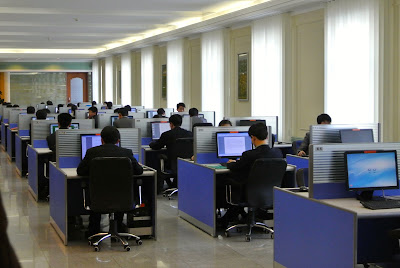
A US delegation recently arrived in North Korea, headed by Bill Richardson and Eric Schmidt. In tow was Sophie Schmidt, daughter of the tech mogul, who wrote an interesting account of her trip. She posted a few interesting pictures and a few anecdotes. The most interesting tidbit occurred in the tech lab

  • The Kim Il Sung University e-Library, or as I like to call it, the e-Potemkin Village
Looks great, right? All this activity, all those monitors. Probably 90 desks in the room, all manned, with an identical scene one floor up.

One problem: No one was actually doing anything.  A few scrolled or clicked, but the rest just stared. More disturbing: when our group walked in--a noisy bunch, with media in tow--not one of them looked up from their desks.  Not a head turn, no eye contact, no reaction to stimuli. They might as well have been figurines.  

No doubt these subjects were given strict instructions on how to act when the delegation arrived. One wonders what there actual job is and where they were herded off to once the performance was over.

Friday, January 18, 2013

The Tourist guild strikes again on the Beautiful Island:
According to the Tourism Bureau, it will not strictly enforce the hotel requirement in the beginning. If a travel agency schedules its clients to stay in star-rate hotel, however, this will help with the passing of the trip in the review process.
Are they not merciful...The Organization of Large Hospitality Operators has successfully used it's political and economic clout to create an effective monopoly on the Chinese tourist market. In order to receive a star rating, hoteliers are required to pay a fee to the requisite quasi governmental agency.

Right now there is a middle class Chinese couple in Shanghai looking at a family vacation. The new rules for Chinese tourists has made Taiwan an option for them to visit but increasing the cost of their stay will inevitably push some people to The Philippines, Vietnam or Hainan who will gladly let them stay wherever they want.